Dream of the Red Chamber
China's great eighteenth century novel of the Jia family's rise and fall, circulated anonymously in manuscript. Cao Xueqin's authorship was established by modern scholarship.
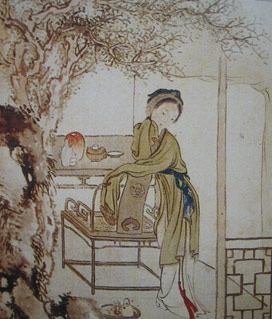

- Original byline
- Anonymous
- Published
- 1792
- Form
- Novels
- Authorship
- Revealed: Cao Xueqin
- Attribution source
- Wikidata P50 (Q8265); Wikipedia note
- Revealed
- 1921, attribution established by twentieth century textual scholarship
- Reason for anonymity
- Unrecorded
- Copyright
- Public domain
- Reference
- Wikipedia · Wikidata
The authorship story
Dream of the Red Chamber circulated in hand-copied manuscripts in mid eighteenth century Beijing, unsigned, its first printed edition of 1791 appearing decades after the author's death. The novel's frame presents itself as a story found inscribed on a stone, a gesture that made the absence of an author part of the fiction. Identification of Cao Xueqin as the author was established by the textual scholarship of Hu Shih in 1921, working from commentary by the author's intimates, and that attribution anchors the field now called Redology. Debate continues over the final chapters, but the core attribution is the documented record.
Questions readers ask
Who wrote Dream of the Red Chamber?
Dream of the Red Chamber was published anonymously and is documented as the work of Cao Xueqin. The authorship became public in 1921 (attribution established by twentieth century textual scholarship). Source: Wikidata P50 (Q8265); Wikipedia note.
Can I read Dream of the Red Chamber for free?
Yes. Dream of the Red Chamber is in the public domain and the full text is free to read at Project Gutenberg.
When was Dream of the Red Chamber published?
Dream of the Red Chamber was published in 1792 without an author’s name.
Related works
- Later revealed
A Strange Manuscript Found in a Copper Cylinder
James De Mille's satirical lost-world novel, serialized anonymously in 1888 after the author's death. The attribution is documented in De Mille scholarship.
- Later revealed
An Essay on the Principle of Population
The 1798 treatise arguing population growth outruns subsistence, published anonymously. Its author, T. R. Malthus, put his name to the expanded 1803 second edition.
- Later revealed
Anti-Machiavel
Frederick the Great's 1740 rebuttal of Machiavelli's The Prince, published anonymously by Voltaire. The royal authorship was an open secret from the start.
- Later revealed
Brother Jonathan: or, the New Englanders
John Neal's 1825 novel of New England life, published anonymously in Edinburgh. The attribution to Neal is documented in scholarship on the author.