Common Sense (pamphlet)
The January 1776 pamphlet that made the case for American independence, signed only 'an Englishman'. Thomas Paine acknowledged authorship within months.
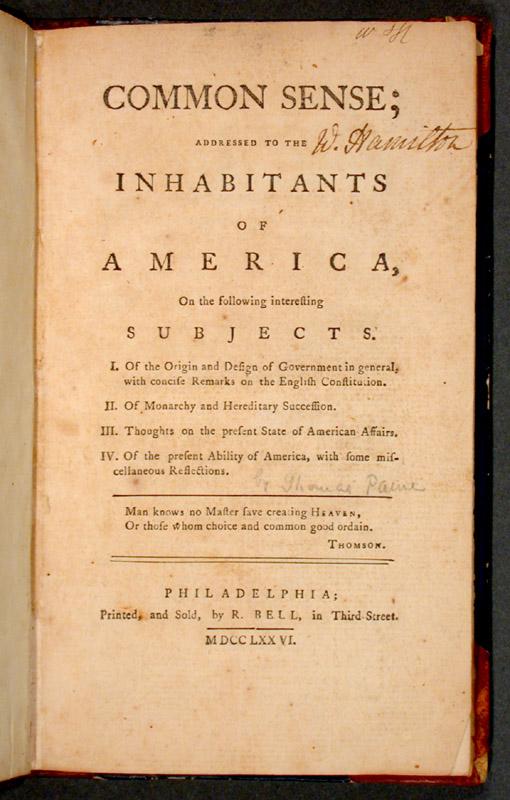

- Original byline
- Anonymous
- Published
- 1776
- Form
- Pamphlets
- Authorship
- Revealed: Thomas Paine
- Attribution source
- Wikidata P50 (Q843940); Wikipedia note
- Revealed
- 1776, authorship acknowledged in print within months of publication
- Reason for anonymity
- Unrecorded
- Copyright
- Public domain
- Reference
- Wikipedia · Wikidata
The authorship story
Common Sense appeared in Philadelphia in January 1776, credited only to an Englishman, and became the most read pamphlet of the Revolution, putting independence into plain, furious prose. Anonymity was practical: the argument was sedition, and printers and author alike had reason for caution. It was also rhetorical, letting the case stand as the voice of common sense itself rather than of a recent immigrant. Thomas Paine's authorship was acknowledged in print within months of publication, and he became the Revolution's most famous pen. The pamphlet remains the textbook case of anonymity as protection for dangerous argument.
Questions readers ask
Who wrote Common Sense (pamphlet)?
Common Sense (pamphlet) was published anonymously and is documented as the work of Thomas Paine. The authorship became public in 1776 (authorship acknowledged in print within months of publication). Source: Wikidata P50 (Q843940); Wikipedia note.
Can I read Common Sense (pamphlet) for free?
Common Sense (pamphlet) is in the public domain, though this site has not yet verified a free full-text source for it.
When was Common Sense (pamphlet) published?
Common Sense (pamphlet) was published in 1776 without an author’s name.
Related works
- Later revealed
An Essay on the Principle of Population
The 1798 treatise arguing population growth outruns subsistence, published anonymously. Its author, T. R. Malthus, put his name to the expanded 1803 second edition.
- Later revealed
Anti-Machiavel
Frederick the Great's 1740 rebuttal of Machiavelli's The Prince, published anonymously by Voltaire. The royal authorship was an open secret from the start.
- Later revealed
Dream of the Red Chamber
China's great eighteenth century novel of the Jia family's rise and fall, circulated anonymously in manuscript. Cao Xueqin's authorship was established by modern scholarship.
- Later revealed
The Sorrows of Yamba
A 1795 abolitionist poem in the voice of an enslaved African woman, published anonymously in the Cheap Repository Tracts. Hannah More's authorship is documented.